Pay Per Click Success
January 19, 2026
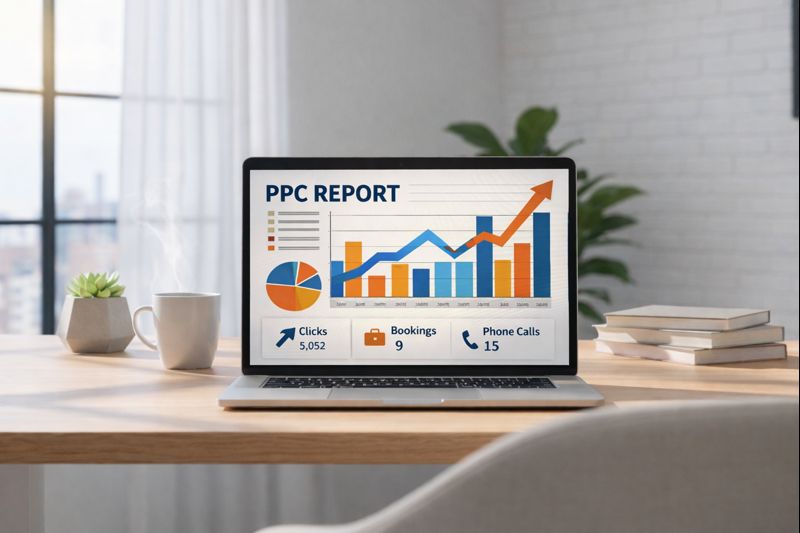
What a Successful PPC Campaign Actually Looks Like (and How to Read the Reports)
Pay-per-click (PPC) advertising is often misunderstood—especially in industries where customers don’t convert on the first visit.
For vacation rentals, destination-based travel, and other high-ticket purchases, a “successful” PPC campaign rarely looks like someone clicking an ad and immediately booking a $5,000 stay. Instead, PPC plays a critical role throughout a longer decision-making process, influencing bookings it may not always get direct credit for.
This article explains:
- What you should realistically expect from a well-run PPC campaign
- How success should be measured beyond last-click revenue
- How to read PPC reports without being misled by incomplete attribution
Why PPC Revenue Isn’t Always the Full Story
In high-consideration industries, most users are in research and planning mode when they search.
A typical journey looks like this:
- A user searches for a destination or service
- Clicks a paid ad
- Visits the website multiple times over days, weeks, or even months, perhaps on different devices
- Returns later via:
- Direct website visits
- A bookmarked page
- An email campaign
- A branded Google search
In many of these cases, the final booking is credited to direct, organic, or brand search, even though PPC played a major role early in the process.
This is not a flaw in PPC—it’s a limitation of attribution models, device privacy settings, and modern user behavior.
Because of this, evaluating PPC strictly on last-click revenue almost always undervalues its true impact.
What You Should Expect From a Successful PPC Campaign
A well-managed PPC campaign delivers results in stages, not all at once.
Early Indicators (Weeks 1–4)
- Increased qualified traffic
- Strong engagement metrics called "Events" in Google Analytics. By default, when you signup with Scurto for PPC management we create these custom events specific to our industry. Early on these events include property page visits or newsletter signups.
Mid-Term Indicators (Months 2–4)
- Growth in repeat visitors
- Increased branded searches
- Higher direct traffic
- More assisted conversions
- Google Events like a User quoting stays, visiting contact us pages or asking questions
Long-Term Outcomes
- Google Events like User reaching a Booking page.
- Increased bookings across multiple channels
- Stronger brand recognition in competitive markets
- More efficient conversions over time as remarketing and optimization mature
Expecting immediate, linear revenue from PPC—especially in travel—is one of the most common causes of frustration, so instead, look at how it impacts the full picture.
Understanding The Scurto Full-Funnel PPC Strategy
Successful campaigns are built around intent and timing, not just keywords. Based on your budget we will determine when and where it’s best to reach your specific audience. Some competitive markets we will need to reach users early on in there journey while if the competition is low all we need focus on is scenarios where they are ready to spend money.
Top of Funnel: Awareness
Top-of-funnel campaigns are not designed to generate immediate bookings.
Instead, they:
- Keep your brand visible in broader searches early on in users’ journey of looking for a vacation.
- Support future demand
These campaigns target demographics and interests and usually will need to include a broad introduction to your area, your brand and your product offerings. Facebook ads are a great way to reach top of funnel audiences but longer tail keywords in Google ads can also function well here.
Middle of Funnel: Google Search
Search ads like on Google or Bing typically function as mid-funnel traffic.
When someone searches “Savannah vacation rentals” or “beach house Tybee Island,” they are qualified—but not committed to a specific brand or property yet.
This is where:
- Destination-based keywords
- Non-branded search terms
- Competitive comparisons
play a major role in introducing your offering.
These campaigns target users that are already familiar with the area. Thus, the ad content speaks more to your brand and product offerings.
Bottom of Funnel: Remarketing
Here the ads focus on “closing the sale” Perhaps bidding on repeat users or focusing on Remarketing ads—often on Facebook and Instagram—target users who:
- Viewed a booking page
- Started a quote
- Browsed specific properties
These users already know your brand. The goal here is re-engagement, not discovery.
Remarketing is the constant reminder of your brands authority in the space – setting a high frequency of showing ads at this phase of their journey will ensure when the time is right to finalize that booking – you are the brand they think of.
One common pattern agencies see: when businesses eliminate top-of-funnel or engagement budgets, direct and organic bookings often decline many months later.
The Metrics That Actually Matter
Because last-click revenue is incomplete, PPC success should be evaluated using multiple layers of data.
1. Traffic Volume and Quality
Clicks alone are not enough. Quality matters.
Key indicators include:
- Time on site
- Pages per session
- Engagement rate
Paid traffic should perform at or near your site average. When it does, it confirms the ads are attracting the right audience.
2. KPI Events (Behavioral Signals)
Key Performance Indicators (KPIs) show intent before a booking happens.
Examples:
- Viewing booking or availability pages
- Requesting quotes
- Signing up for newsletters
- Clicking to call
A rising volume of KPI events indicates that users are actively considering your offering—even if they haven’t booked yet.
3. Direct Conversions (With Context)
Phone calls and direct bookings from ads are important—but should be viewed as a portion of total impact, not the whole picture.
Tracking limitations, device privacy settings, and cross-device behavior mean some conversions simply cannot be attributed cleanly.
4. Lift in Other Channels
One of the strongest confirmations that PPC is working is improvement elsewhere:
- Increased direct traffic
- Growth in organic search
- Higher branded search volume
These are often downstream effects of effective paid campaigns.
How to Read PPC Reports Without Being Misled
When reviewing reports, avoid these common mistakes:
- Focusing only on ROAS or cost per booking
- Ignoring engagement and KPI trends
- Comparing PPC revenue in isolation without year-over-year context
- Expecting Facebook ads to behave like Google Search
Instead, look for consistency and momentum:
- Are engaged users increasing?
- Are more people reaching high-intent pages?
- Are other channels strengthening over time?
These patterns almost always precede stronger booking performance.
Final Thoughts
A successful PPC campaign—especially in travel and other high-ticket industries—is not about chasing immediate conversions. It’s about:
- Capturing intent
- Staying visible during long decision cycles
- Supporting bookings that happen days or months later
When evaluated correctly, PPC becomes one of the most powerful drivers of sustainable growth—not just another line item on a report.
Let’s work together to get the most out of your PPC Budget!
Make the move
Take the next step in your vacation rental company's evolution and join us! Level up with our over 24 years of digital marketing experience in the short-term rental industry and superb customer support.